
It’s slightly trickier than you think it should be! Here goes:
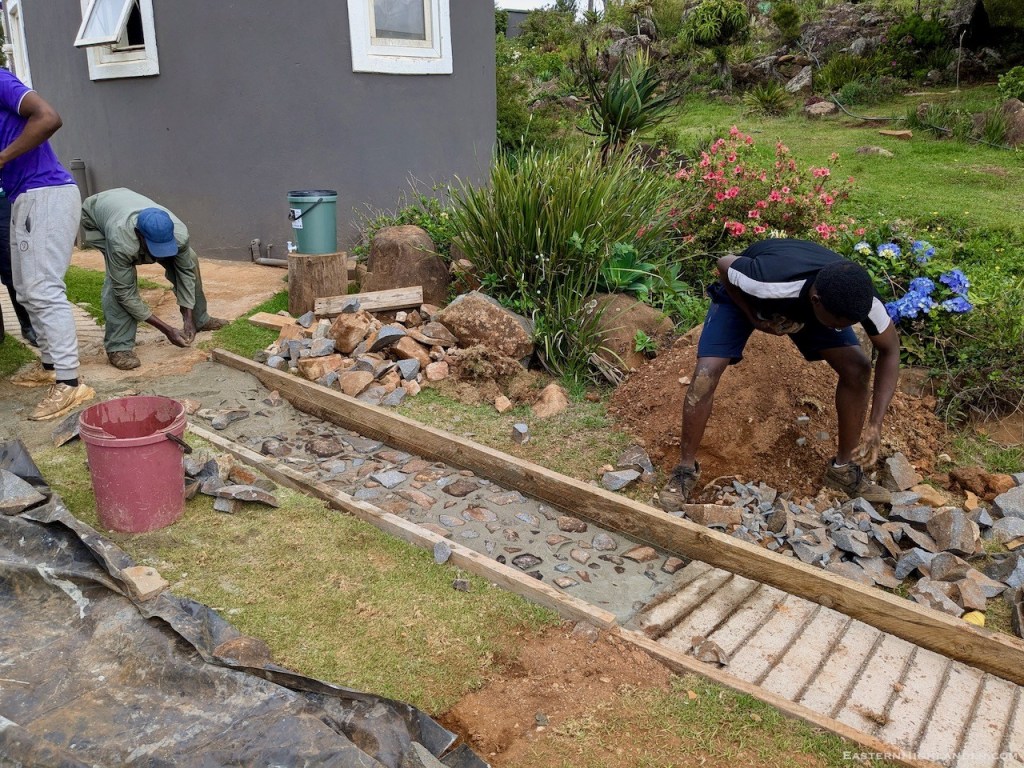
The starting point is the wooden ‘form’ (‘foroma’ locally). Easier to show than explain: Mr Tongai has his foot in one segment of one form, below
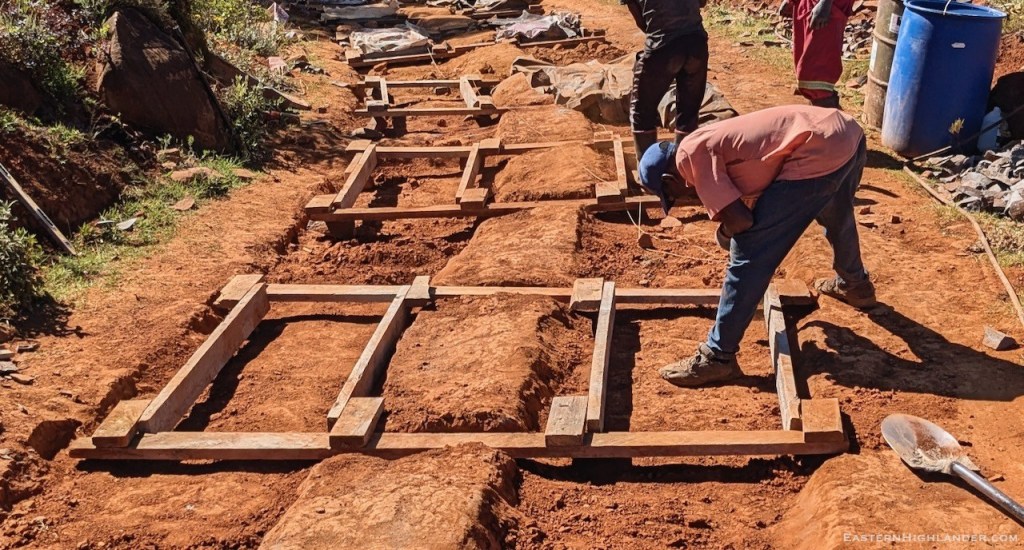
Two parallel segments each 60 cm wide and 150 cm long – wood on its short side. Held together by two pieces on the flat so that people can drive down the middle and on one side with out too much disturbance (easier said than done). Not that tightly nailed to give flexibility and to allow deconstruction of a side when needed. 90 cm internal spacing: inside to inside of the two segments.
We started out on a less steep hill to get our hand in.
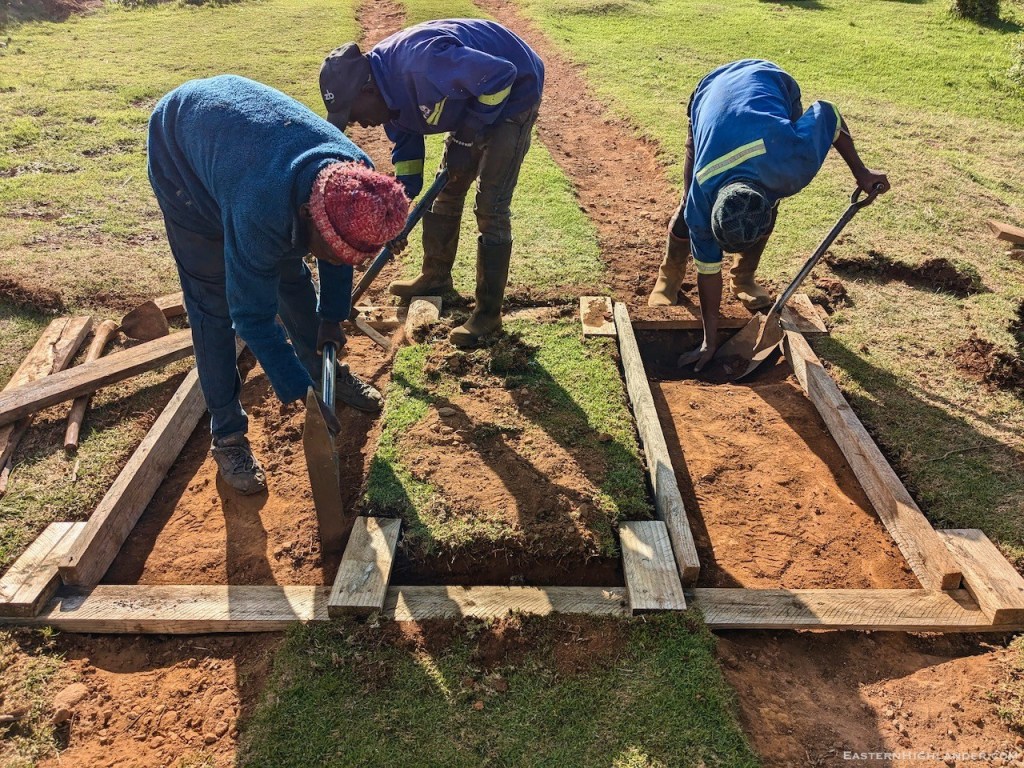
There are so many ‘degrees of freedom’ that it’s best not to think about them too much, just get stuck in and your common sense will do the rest, with a line, steel pegs (+hammer), and spirit level.

The process
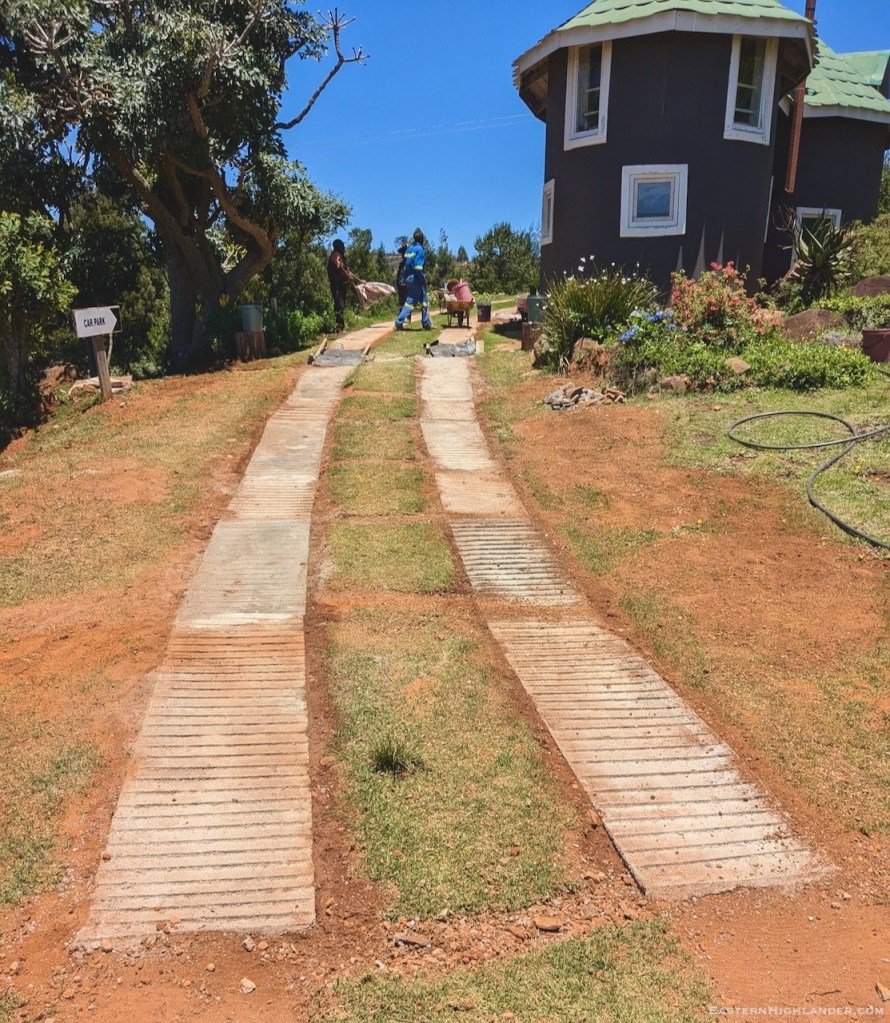
Each segment is 1.5 m long and we make two parallel segments at a time using one of our wooden ‘forms’. Then we jump 1.5 m, leaving a gap, and put another form down and make the next pair of 1.5 m segments.
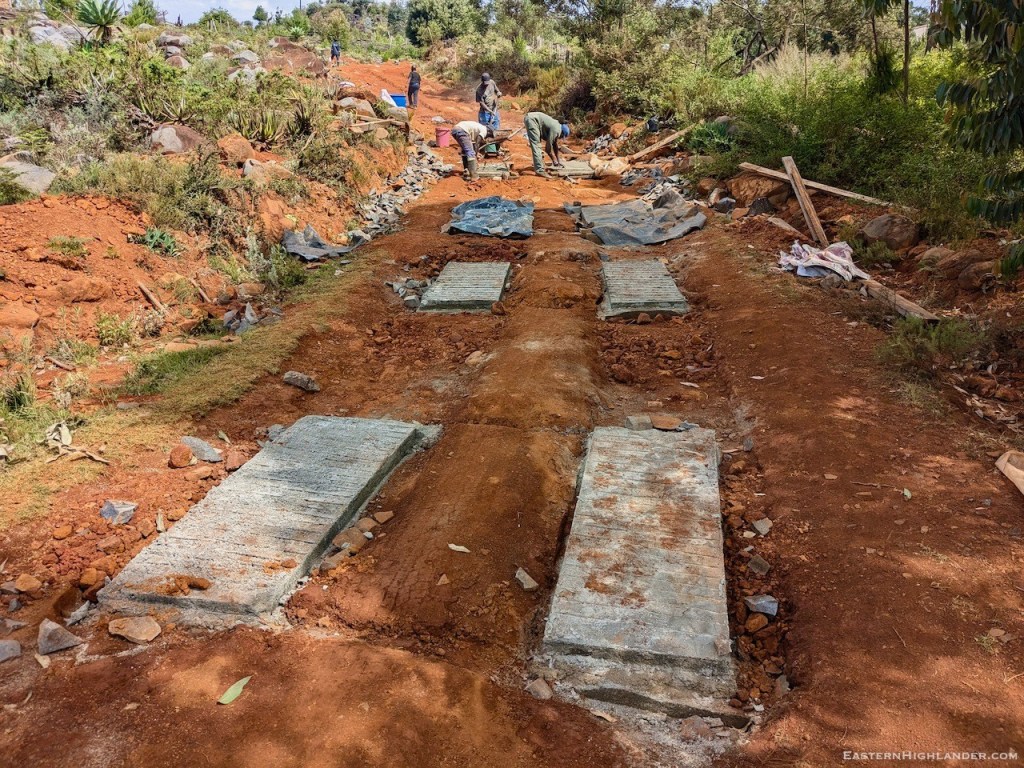
In Maths sense: we make segments 1, 3, 5, 7 then go back and make 2, 4, 6, etc. The even numbers e.g. 2 are just joining two odd numbers, before and after e.g. 1 and 3, so they are quite a bit easier because all the angles and gradient are already set by the existing segments, the odd numbers.
Where the trouble begins
Positioning the initial, odd numbered, segments, going up hill, is a bit of an exercise. Variables to be considered include the following:
Depth: down to – pfungawe/ solid foundation for the concrete. May have to go deeper on one side which upsets things a bit from a side to side perspective and your form does not account for this.

Height: thick enough to be solid, I’d say we were not less than 15/20 cm thickness.

Alignment: a) with the direction of the road, and b) crucially, because we are jumping ahead with gaps, that the eventual alignment of all the joined up sections creates a smooth, fluid curve (of short 1.5m straight segments).
The Form is not perfect: the form may well be bent / not perfect so the form itself may create ‘challenges’ by creating a higher apparent level for the concrete on one side. See next section.

Overfilling one of the segments: because we use a wooden ‘form’ there is a huge, undeniable, magnetic force on who ever is filling the concrete and stones to fill in the form to the top of the parallel planks, whereas the string/line (that should be in place) going from existing form to existing form says otherwise. I.e. the level of the concrete may need to be lower than the side planks of the form.
Is an individual segment on a uniform slope/gradient/plane: we haven’t really bothered about this as it ‘just seems to be alright’ as the form is only 1.5 m long.
Is each single segment level: is an individual segment level, left to right – mostly we have not been so far.
Anchor
Each segment has a 25 cm deep hole close to its lower end to anchor it in the ground and prevent any down hill movement (reaction) caused by the (action) driving wheels of a heavy truck of sand.
Onwards and upwards: the main event
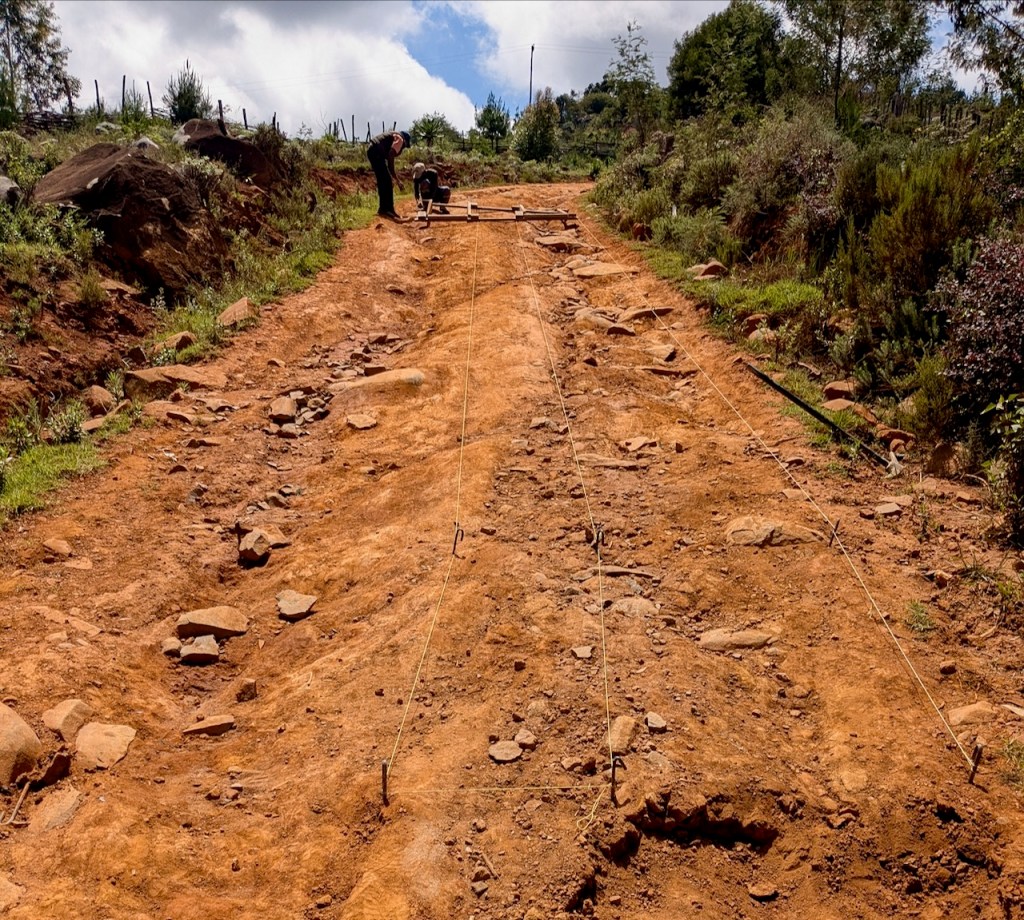
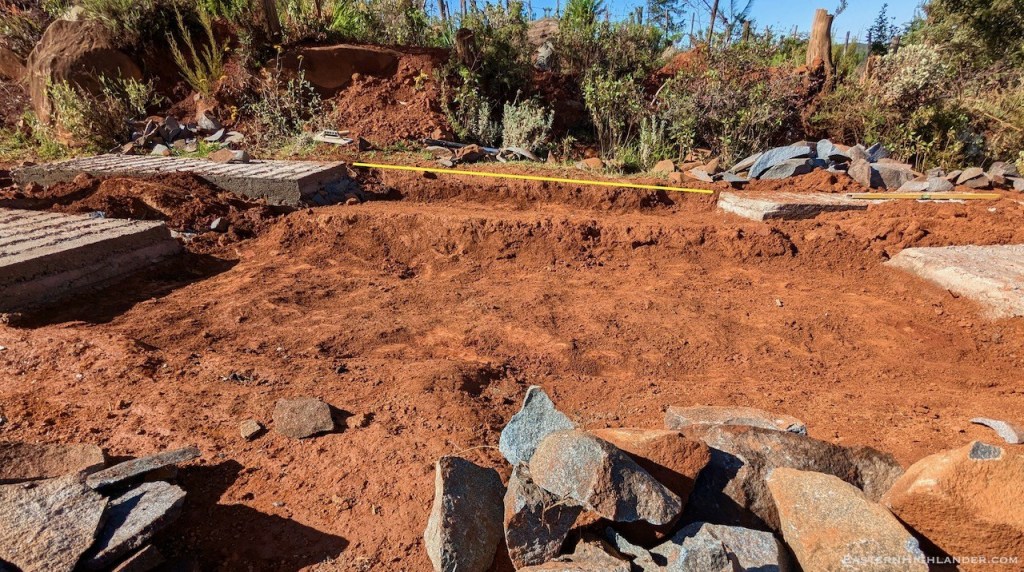
This time we decided to dig out our trenches in advance to improve alignment (height)


Cars need to keep left!
 Eastern Highlander